OmniGen AF is, with more than 130 scientific publications, one the most extensively researched and proven immune modulators on the market. Feeding OmniGen AF daily helps to support the immune system, especially during expected and unexpected stress events.
A well-functioning immune system leads to improvements in udder health and fertility. In addition, cattle fed OmniGen AF cope better during hot weather. It has been available in Europe since 2012 and, as of 2024, is also permitted for use on organic dairy farms.
Falling milk prices are putting pressure on dairy farmers to evaluate every investment more critically. This often leads to a tendency to “save” money by reducing feed costs. But this is exactly where a major risk lies. Recent research published by the Journal of Dairy Science shows that OmniGen AF continues to deliver positive financial value even under challenging market conditions.
The financial benefits in production, health, and fertility combined outweigh the cost of feeding it. In other words: stopping OmniGen AF may seem like a saving, but in practice it can lead to missed income.
The study outlines that with any financial investment decision, there are four possible outcomes:
An incorrect decision can be observed in two ways:
1. You decide to invest in the feeding of a product, but that decision does not result in the expected benefit. This in known as a Type 1 error.
2. Or —the costliest outcome— occurs when you decide not to feed a product, when it would have delivered the expected benefit. This missed-profit scenario is known as a Type 2 error.
A correct decision can be observed in two ways:
3. You decide to invest in the feeding of a product, and that decision results in the expected benefit.
4. You decide not to feed a product, and that decision turns out to be correct.
When we apply these four possible decisions to the use of OmniGen AF, the following picture emerges:
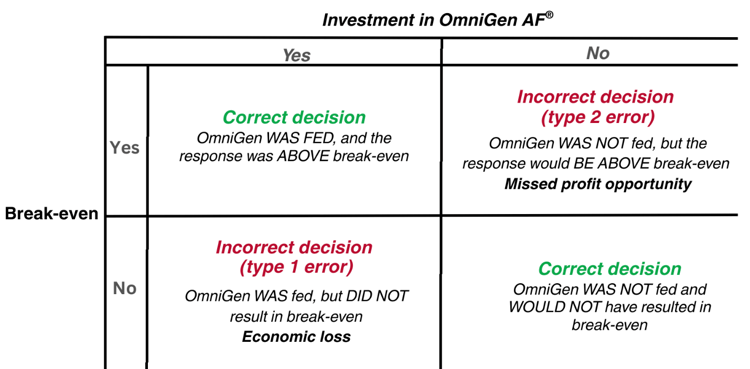
Using two large data sets investigating the effects of feeding OmniGen, Casarotto et al. (2024)* evaluated the cost of feeding OmniGen against the four benefits observed:
The assumptions for this analysis are based on an earlier study by Casarotto et al. (2020)**. For each scenario, the cost of a wrong decision is calculated — both when OmniGen AF is fed without result (Type 1 error) and when it is not fed even though it would have been profitable (Type 2 error).
When only milk yield is considered, the calculated financial cost of a Type 1 error is $2.62 per cow per 90 days, calculated to occur 38% of the time when OmniGen was fed. Conversely, a Type 2 error results in a missed income of $9.92 per cow per 90 days.
As more benefits of OmniGen AF are included in the analysis, the likelihood of a Type 1 error decreases, while the likelihood and impact of a Type 2 error increases. For example, when milk, health, and fertility are combined, the product is profitable for certain (no chance of a Type 1 error), while the economic cost of a Type 2 error rises to $45.08 per cow per 90 days.
The values in the table are expressed in US dollars and based on the economic parameters of the original study. In Europe, milk prices and feed costs differ, but the underlying error probabilities remain identical.
When all benefits are considered and both error probabilities and error costs are weighed, feeding OmniGen AF remains economically profitable because the potential gain from a positive response far outweighs the limited risk of a Type 1 error.
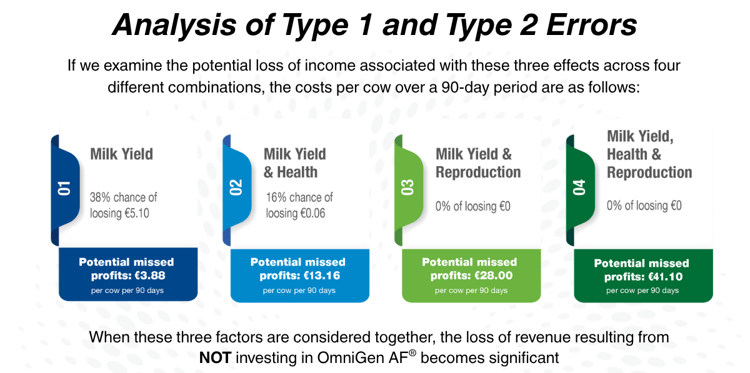
This research demonstrates that the chance of losing money by feeding OmniGen AF is very small, while the chance of missing out on profit by not feeding it is very large. Since OmniGen AF is highly likely to deliver a positive return over a typical 90‑day period, understanding both the probability and cost of Type I and Type II error enables more informed, confident investment decisions, clearly favoring the use of the product.
OmniGen AF helps keep your herd healthy, productive, and profitable — even during challenging market conditions with falling milk prices.
References
*Casarotto et al., 2024. Application of type I and II error analysis to support economic decision-making of using an immunomodulator feed additive. J. of Dairy Science, 107(12), 11796-11802.
**Casarotto et al., 2020. Effect of feeding an immune modulator to multiparous Holstein cows during the dry period and early lactation on health, milk, and reproductive performance. Anim. Feed Sci. Technol. 267:114527.
Subscribe to our blog updates and receive new blog articles in your mailbox.


.png)